Friday, November 7, 2014

Vipassana - A little dhyaan and a lot of silence

How does it feel to be silent for 9 days? To meditate, or try to, for 10 hours each for 10 days.

To me, the silence felt good. The attempts at meditation were not particularly successful but worthwhile nevertheless. Goenka's philosophy of salvation, however, was what I was least receptive to. Like any life-guiding philosophy, Vipassana affects each individual differently, and here's my personal experience of it.

During the long ten days, we maintained silence from the night of Day 0 to the morning of Day 10. The silence could be broken only to talk to the teacher to ask or answer questions about the meditation technique or, to raise any issues with the management. Besides an average of 2-3 sentences every 2 days, I was silent for the rest. Some folks gave up on the silence around the fifth day, but since this was the easiest task for me, I stuck. It was especially easy since our phones had been deposited with the management on Day 0.

The silence clears your mind of a lot of clutter. With no WhatsApp and Gmail, it's easy to focus on one train of thought and go deep. It helped me reach decisions on some life issues and think about the path I've chosen.

While the silence came easily to me, meditation was a different kettle of fish altogether. My silence did not extend to my mind. It was full of thoughts. Keeping it focused on my breath and body sensations was a constant battle. I did get better as the days passed but my interest waned after Vipassana discourses.

EL Maestro Goenka
S. N. Goenka (Photo credit: Wikipedia)
This was surprising as I'd enjoyed the discourses till then. In the daily video discourse, Goenka speaks of the theory behind practising Vipassana in the style he teaches. In the first few days, he's quite areligious and irreverent. Faith without the trappings of religion made absolute sense to me. However, in the later days, he talks more about how Vipassana is 'the path' to salvation where religion has failed. He also tried to explain how each religion talks about Vipassana in different words. Surprisingly, I had no problem with that, maybe because I've always appreciated politics. However, the repeated focus on how engaging in Vipassana would cure the sins of my past births and take me towards salvation, was a turn off.

Overall, the ten day course was definitely an enriching experience. It pushed me to crystallize my thoughts on life and what faith means to me. But, would I do it again? Probably not. Unless I need the silence enough to ignore the salvation mantra. 

Sunday, February 23, 2014

When do you stop being a newbie?

Credit:
The Partially Examined Life
In a week’s time, I will be completing my first quarter as a Field Manger at Dimagi. Given the myriad of things that I do as an FM, sometimes I feel like an old hand. And then there are times, when I ask questions about the simplest of tasks, like how to load multimedia for a CommCare app on a Java phone. When will I see that milestone that says ‘You are now exiting newbie zone’?

In these three months, I have travelled to Rajasthan, Gujarat, Uttar Pradesh and Madhya Pradesh. Three states were for work. Gujarat trip was to meet friends and utilise the ‘work from anywhere’ policy. I planned that just after my maiden field visit. Did the newness wash away in waters of river Narmada?

On that first visit, I experienced the joy of helping an elderly field worker, learn how to type on a smartphone. The process of teaching has deepened my well of patience but, I am yet to be as engaging or creative a trainer as I could be.

Saturday, November 2, 2013

Loosely inspired from Pasta Primavera

The saga of my invention test with penne pasta. This desi version was derived from Pioneer Woman's Pasta Primavera.

Mom and I were doing Diwali shopping at the supermarket when I found a shelf of pasta. My last search for any pasta in this place had proved unfruitful so spotting a packet of penne pasta, one of my favourite kind, led to a quick grab.

Monday, October 21, 2013

Baby steps of my food photography

After a long soak, this blog is ready to sizzle. I am armed with a spatula and a camera, along with my trusty laptop. The next week would have posts about my cooking and its pictures. How did I go from being a multipurpose, could-be writer to food photographer and cook? The cook part is because the sous chef at home is on leave for a week, so it’ll be me manning the kitchen. The food photography has a more interesting story. 

My interest in food started dating my passion for photography during a Visual Communication class, in last September. Their lovechild is less than a year old now. She uttered her first word in January, it was of course garble, but it sounded so sweet to me: 


The next baby-book milestone was when she started walking on her knees: 

Monday, April 8, 2013

6 Lessons from the Man Who Drives Harley Davidson


Here are six lessons from today's guest session with Anoop Prakash, MD of Harley Davidson India. While we've had many corporate leaders as guest speakers at Young India Fellowship, Anoop stands out as he has worked in the US Marine Corps and been a part of the Bush Administration. Anoop was born in the US, studied at Stanford and Harvard Business School and has had a diverse career before moving to India in 2009. He put together his life-lessons for us as six bullet points. 

Purpose of your job matters
As most of YIF fellows are at the cusp of choosing their careers, Anoop outlined what is it that he looks for, every time he changes jobs. The name of the company and the job title doesn't matter but what matters is what is your purpose in the job and who is your boss.

Tuesday, February 19, 2013

Gandhi but not Gandhi 1.1

I wrote about the Gandhi dream in my last post. This is a continuation of that dream.


From Ritwik’s tutorial, my brain moved to Gandhi talking to a villager in Sabarmati Ashram. Gandhi was passionately describing his concept of an ideal village. The villager then asked Gandhi that why doesn’t he take another tour and spend more time in villages this time.

Monday, February 18, 2013

Gandhi but not Gandhi 1.0

I knew Gandhi wrote a lot but I did not realise that every scrap of paper he wrote on, is preserved. I was reading some texts for the course Gandhi’s Critique of Modernity when I came across this website that has a collection of his letters. These are not just political letters or letters published publicly by Gandhi, these are everyday letters to his sons, Ashram dwellers, and so on. When there is so much material available in his own lucid words, Gandhi should be an easy to understand figure. Alas, that is not to be. He was a prolific thinker and kept grappling with his experiments with truth until the end. 65 years after his death, the reader’s quest is to wade through numerous pages to grasp the essence of what Gandhi said.

I have been so engulfed in Gandhi’s writings that they are cropping up in my dreams now. In last night’s dream, I kept trying to figure out where Gandhi’s Hind Swaraj ideas got sidelined by his larger-than-life image of ‘Bapu’.

Wednesday, January 16, 2013

Swimming in Ideas

When I saw the course Gandhi’s Critique of Modernity on YIFP curriculum, I expected it to be an extension of Makers of Modern India by Rudrangshu Mukherjee. Gandhi was the only leader whom we did not discuss in that course so I was looking forward to a story-telling of Gandhi’s life and reading some of his writings. Critique of modernity was a phrase for me that did not go beyond what Gandhi wrote in Hind Swaraj. Coming from a non-social science background, my only introduction to such movements has been through Gil Harris and Anunaya Choubey in their courses on Shakespeare and Art Appreciation respectively. So here’s how the cloud of ideas has influenced me so far, where the pivot is learning about modernity.
I am an economist and an engineer by training, so rational thought is like the core of my being. It is surprising that while championing rationality, I never stopped to define or explore what rationality is.

Monday, November 26, 2012

विचारों की यात्रा

डॉ पुरुषोत्तम अग्रवाल
क्रेडिट: बुक लवर 

आज बहुत दिनों बाद हिंदी साहित्य से रूबरू होने का मौका मिला| अवसर था डॉ. पुरुषोत्तम अग्रवाल की पुस्तक के विमोचन का| किताब का नाम है “हिंदी सराय : अस्त्राखान वाया येरेवान”| विमोचन डॉ. कर्ण सिंह द्वारा किया गया जो कश्मीर के महाराजा हरी सिंह के पुत्र हैं और राज्य सभा सांसद भी हैं| अस्त्राखान रूस में है और येरेवान अर्मेनिया की राजधानी है| यह किताब वैसे तो अग्रवालजी की येरेवान और अस्त्राखान यात्रा का विवरण है, पर साथ ही साथ उन्होंने १७वीं सदी में अस्त्राखान में जाकर बसे भारतीयों के बारे में भी बात की है| जिस तरह से उन्होंने इतिहास, संस्कृति और विचारधाराओं को अपनी किताब में कुशलता से बुना है, उसके लिए कई वक्ताओं ने उनकी पुस्तक को मात्र पाँवों की यात्रा का विवरण की जगह “विचारों की यात्रा” का वर्णन कहा|

पहली वक्ता थीं सुश्री मन्नू मित्तल जो जवाहरलाल विश्वविद्यालय में इतिहास ही प्राध्यापिका हैं| उन्होनें एक बड़ी रोचक बात बताई – हम जो कपड़ों में “अस्तर” लगाते हैं, वो शब्द अस्त्राखान से आया है| हुआ यों की अस्त्राखान में कपड़ों का, खासकर फ़र का व्यापार होता था| और पहले कपड़ों में फ़र लगाया जाता था इसलिए वो अस्तर हो गया| संस्कृति के आदान-प्रदान के ऐसे कई सबूत मिलते हैं, जैसे कि कोणार्क के मंदिर में सूर्य देवता स्लाविक जूते पहने हुए हैं जबकि कोई भी हिन्दू देवी-देवता जूते पहने हुए नहीं दिखाए जाते|

Sunday, November 4, 2012

Chandni Chowk : A Heritage Walk

The alarm rings at 8, I want to sleep a little more on this hazy Sunday morning. But, I get up because the glimmer of Chandni Chowk beckons. A heritage walk to Jama Masjid nestled withing the old, walled city of Shahjahanabad is an exercise in seeing fleeting glimpses of the 17th and 19th century. The walk director conjures up images of a proud Shah Jahan sauntering into his beautiful city in 1648 and Mirza Ghalib lamenting its demise after the freedom struggle of 1857.

Isfahan during 17th century. Credit: Isfahan Municipality Portal
Shah Jahan's new capital was built to outshine the city of Isfahan in Persia, and it did so. Shahjahanabad was a gorgeous walled city with 14 gates and a webbed layout. Delhi as a city has been constantly recreated and this counts as the 6th among the 7 Delhis. 4 of Shahjahanabad's gates exist as structures today: Kashmiri gate, Ajmeri gate, Turkman gate and Delhi gate. We saw Kashimiri gate during the heritage walk on the 1857 mutiny.

Credit: www.traveladventures.org
This walk began at Chawri Bazaar metro station and ended at Chandni Chowk metro station. But, this little space houses sprawling dimensions of heritage.

Tuesday, October 23, 2012

From Glory to Dust and Blood: Trajectory of Hyderabad


A researcher is bound by the rules of her craft to remain objective and detached from the subject.  A writer, on the other hand, can give something of herself to the writing. This is clearly seen in the different approaches taken in these two books: Muslims in Indian Cities: Trajectories of Marginalisation and The Untold Charminar: Writings on Hyderabad. While the first book is edited by two academicians Laurent Gayer and Christophe Jaffrelot, the second one is by advertising professional Syeda Imam.

Tuesday, August 28, 2012

Dedication to Prof. Suresh Ramaswamy

Sura, as he was affectionately called, was a gem of BITS Pilani. He was one of the best individuals I knew - able administrator, diplomat, brilliant professor and a decent person to the core. He always had an ear for everyone, be it a student, parent or hostel assistant. Even after changing posts from Chief Warden to Dean, Administration, his was the office to go to, if you wanted your case to be heard. He understood students, was generous with praise and recognised their faults too. I always loved listening to him speak on the dais because he spoke briefly with simple words, yet managed to inspire. 

I'm still trying to believe that one of the pillars of my college life is no more. I knew him first when I was a college kid in first semester, fresh and eager. His was a presence that was always there for me, even if we didn't talk for months. I saw him last on 5th August, 2012 sitting in his home. We talked for almost an hour with his young daughter playing on the carpet.

Many of us remember him with a bicycle tyre in LT, demonstrating how the gyroscope works. That is the role in which I saw him first, a Physics professor. He painstakingly explained waves concepts to me in his office a couple of days before Physics I compre. I was, and still am, a complete novice at Physics, but he gave me the confidence to attempt to solve those problems. 

I next knew him as BITSAA coordinator and he became Sura for me, a relic of his Pilani days. He was genuinely interested and involved in all activities. I see him sitting with Vishrut bhaiya and others discussing the Director's Tea Party menu with Sharath Babu. In second year, I got involved in too many things and no longer had time for BITSAA. When I was given my walking papers, albeit nicely, I remember his canny comment while passing by in the corridor "They booted you out? "

In March 2009, he succeeded Prof. A. V. Kulkarni as Chief Warden. I worked with both of them as part of Election Commission. Sura always made time for the team. We even had meetings sitting on the stairs outside B Dome so that we could get work done after his office hours. This was the first time when the whole responsibility of the elections rested on the Chief Election Commissioner. He did not impose his decisions and let the team do its work. Because of his genuine understanding and assured support, I knew that if my decision was right, I could've told a candidate to do their worst. He came to each audi debate, never intervened, but for me, he was like the wall who would be there if things went awry. 

In March 2010, a group of friends and I were in a bus accident. I lost my sight for a few minutes but was conscious. My vision was wavering between dark and light on the way to the hospital but I managed to dial his number. I thought of him first because I knew he would care about the 8 students in the bus and also, because he had the authority to ensure we were taken care of. He came promptly with the hostel superintendents to the Chicalim Cottage Hospital and stayed with us for the whole day in GMC. He talked to each of our parents on the phone, reassuring them that their wards were being cared for.

I thought my last interaction with him would be in the Director's Tea Party in 2011. I was speaking as a going-out student on the dais where I had compèred three years before. But I ended up attending another Tea Party in 2012. To my surprise, he remembered what I had spoken about a year ago. He wasn't one of the professors who just nodded and smiled. 

Despite all that he had achieved at BITS, Sura was the epitome of humility. I asked him for a recommendation to HBS and GSB in July 2011. He frankly told me that he'd never written a business school reco and to tell him what's the format. When he saw me at the convocation in August 2011, the first words out of his mouth were "Sorry, I didn't get the time to write your recommendation letter". I was astonished. The reco wasn't due till October, it wasn't even on my mind, but he remembered! Out of the three professors I asked, he was the only one who did not ask for a write-up. He was the first one to upload the recommendation letters, despite being pressed for time as the Dean, Administration.
  
As I am writing this, there are many more memories which come tumbling in. I always admired him. Looking back, I realise that he was the only professor I came close to adoring. He was vital to BITS Pilani K. K. Birla Goa Campus. My mind is still refusing reality. I keep thinking what will Sura think when he reads this.
Enhanced by Zemanta

Thursday, August 9, 2012

Word Picture

At the elemental level, art exists because it appeals. This post is an attempt to capture an oil-on-canvas painting in my words. Will the image I evoke and the real work match?

Tuesday, July 31, 2012

Cloaks

The girls’ laughter could be heard on the street outside. Young girls dressed in pretty clothes were participating in a feast. It was the ninth day of Navratri, and they were in high demand. This was the third house they were visiting that day. Nine pre-pubescence girls are fed and worshipped at the end of the nine-day fast as they are believed to be avatars of the Goddess Durga. The delicious smells and tinkling sounds brought another girl to the door. But she was so filthy and grimy; it was hard to guess her age. She came with the hope that she would get some leftovers. Maybe they would give the food to her before it went out as garbage; and she would not have to rummage for her meal in a bin again. She stood near the door and waited silently to be noticed. It was not long before a stern woman came to shoo her away from the doorstep. In desperation, the girl clutched at the woman’s sari. The woman screamed, “Satyaanaash, now I’ll have to bathe again”. The sari was quickly extracted from those tiny hands and the girl was chased out of the gate. The sanctity of the woman was soiled by the touch of the low-born urchin. You must indeed be born in the right house to have Devi Durga reside in you. 

I live in a society which places emphasis on how people dress. Especially in times of festivals, there is multi-hued, sparkling splendour in shops and homes, as if stars have descended on the earth. But closets don’t just hold shimmering saris and glittering jewellery, some store cloaks too.

Monday, July 30, 2012

Open Letter to a Friend

Hi,

We had talked about hypocrisy in people during one of our long talks. You and I were so strongly critical of duplicity and hypocrisy and we’d said that it was the first turn-off for us in a person. I still remember you saying “how can people do this, be like this?” 

I recently read a couple of essays which brought that conversation to my mind. The first was George Orwell’s ‘Shooting an Elephant’.

Sunday, July 29, 2012

Meri Kahaani 1.3 : Putting it in Context


Here's the last post in Meri Kahaani series. The three parts already posted are:

Credit: Star Campus
If you have read The Tempest, here is the explanation of how Meri Kahaani is a re-imagination of the play. Prospero, Caliban and Sycorax are spread across many characters like in Tayeb Salih’s Season of Migration to the North. This novel by Tayeb Salih is a re-imagination of The Tragedy of Othello, the Moor of Venice, another play by Shakespeare. The British rulers are Prosperos while the Mughal rulers are Sycoraxes. Caliban corresponds to Maharana Pratap in the Mughal era and Subhash Chandra Bose in the British period. There is no back-story of deception to Prospero’s arrival as in the play so, the characters of Alonso, Sebastian, Gonzalo and Antonio are absent. Stephano and Trinculo are visualised to a certain degree as the Germans and Japanese in the sense of Caliban’s collaborators in the British period.
As Ariel is a spirit, he can learn any language from the people he comes across. But, as a spirit existing on an island, he would not have spoken all human languages. When Sycorax came to the island from Algeria and then Prospero from Milan, he had to learn their languages in order to communicate with them. Taking Sycorax as Arabic influence and Prospero as European/English, I have drawn a parallel between Ariel's life under Sycorax to Mughal era and Prospero's regin over Ariel to British Raj in India.


Correspondence between The Tempest and Meri Kahaani


Bhadrapada Shukla Navmi is a date, the ninth day of the month of Bhadrapada in the Hindu calendar, Vikram Samvat. Bhadrapad Shukla Navmi in Vikram Samvat 2063 would be 22nd August 2007 in the Gregorian calendar. Since the Gregorian calendar was not used in Akbar’s time in India, Ariel has only the Hindu date as reference. 

Lastly, Ariel is unnamed in the blog posts for two reasons: first, they are written in first person and second, his identity keeps changing with time, so there is no single label to put on him.

Enhanced by Zemanta

Saturday, July 28, 2012

Meri Kahaani 1.2 : Transient yet Eternal 2.0

My cellphone’s shrieking alarm woke me up some time ago. Here I sit, fingers poised above the keyboard, wondering how best to capture the cacophonous, jarring period of Indian history that was the British rule.

Indo-European language family tree
I had to master English in order to function effectively under the British officials. Here again, the script was completely new to me. I had become accustomed to writing from right to left, now reverse gears were required again. The locals treated the English as “pardesi hamlaavar” or foreign invaders. But in my study of languages, I discovered that Hindi and English belong to different branches of the same Indo-European language family. Despite the metamorphosis that happened in both languages, there are some cognates i.e. words with same roots: naam-name, janam-generate, mata-mother, patthar-Peter etc. The study of English opened up a whole new world of literature to me as most of European literature was available in English. I could have read about new scientific inventions too. But this knowledge was inaccessible for me. I was supposed to memorise the name of every king and queen who sat on the British throne but my knowledge of science remained confined to the basics.

Deliberate suppression can make even a rusted spring exert its strength. So it was with me. I thought of what the British gave me but it was not sufficient to quench my soul. When they chanted that their religion and culture was supreme, my ancient pride rose up. While I was studying, I was appalled to hear of the cruel treatment meted out to those who dared to rebel. The heavy handedness kindled contempt within my breast but I did not dare to speak out for fear of retribution. My English mind then created these lines:

Blown from cannon, hung and shot,
Torn in pieces, India to rot,
Bayonets sprouting blood and gore,
Stop the carnage, Please no more.

The sepoy mutiny of 1857 was a violent bloodbath. The Indian National Congress had been set up in 1885 but it only discussed the issues of English-educated Indians. I was heartened by the first flicker of sovereignty when Annie Besant founded the Home Rule League with Lokmanya Tilak in 1916. I had supported Britain in the First World War. After the war was over, Swaraj beckoned. But, it was not granted. I served the British again in World War II. By that time, I was fully supporting the Indian freedom movement led by Mahatma Gandhi. I participated in the demand for freedom, although being a civil servant made that a low-key request. There were some who disagreed with this style of freedom movement. They were dubbed radicals and ultimately they turned to violent revolution in order to overthrow the British Rule. One such individual was Subhash Chandra Bose. He sought help first from Adolf Hitler in Germany and later from Japan to overthrow the British rule. The attempts did not succeed. Also, Subhash Chandra Bose realised that Germany and Japan both were becoming the masters in this alliance. He left Germany for this reason. Even though his Indian National Army took control over the Andaman and Nicobar Islands, their administration remained in the hands of Japanese navy. An iconic figure, Bose has been lost in the wild after his alleged death in 1945.

Two years after World War II ended, India got independence in 1947. The farewell given to Lord Mountbatten was India’s last offering to the British rule. After Independence, India has seen its ups and downs while fighting the legacy of its colonial past and rediscovering its ancient heritage. English, given as a tool by the British, became India’s strength in a globalised world. Today, an average Indian whose mother tongue is supposedly Hindi, speaks in a mixture of Hindi, Urdu and English. School textbooks often emphasise the slogan ‘unity in diversity’ for Indian population. But I would say this is not merely unity: It is creation of a new identity where being Indian transcends any single linguistic identity. Children here are born polygots. Today, I can be perfectly understood in India when I write like this:

Viraasat ki neemat lekar, present time ki lagaam pakado
Vartamaan ki seedhi chaddhkar, future ko bright banao
Meaning:
Taking the blessing of your inheritance, catch the reins of your present
Climbing on the stairs of your present, make your future bright


The first part of this story is in the post Meri Kahaani 1.1. If you are wondering what got me started on this track, read Meri Kahaani 1.0

Enhanced by Zemanta

Friday, July 27, 2012

Meri Kahaani 1.1 : Transient yet Eternal 1.0

The context for this story is in yesterday's post Meri Kahaani 1.0
It was a quiet day at the office today. But too much silence perturbs me. Is this the portent of tempestuous times ahead? I looked at the calendar and realised that today is Bhadrapada Shukla Navmi. Many centuries have gone by, but I can never forget that on this day I became a part of the Mughal Emperor Akbar’s court. As a Central Government bureaucrat, I know the approved markings of India’s border. But I also remember the India that was unified for the first time by Akbar. If I tell tales of those times, will anybody believe me?

The Mughal rule began in India when Babur defeated Sultan Ibrahim Lodi of the Delhi Sultanate in the Battle of Panipat in 1526. I was serving Krishnadevaraya at that time. Kannada was the language used most in his court. From there I went to Raja Bharmal’s in Amber. When he married his daughter to Akbar in 1562, I moved again and became a part of Akbar’s court. I had learnt Hindi in Amber and had hoped to use it in Akbar’s court too. However, despite Akbar’s support for Hindu culture and Hindi; being his courtier, I was forced to learn Persian. This was completely different from any language I had learnt before. My knowledge of Sanskrit had always helped me pick up the language of any court in India. Whenever I struggled, I used to remember this shloka:

Abu'l-Fazl ibn Mubarak
presenting
 Akbarnama to Akbar
(Credit: 
Wikipedia)
उद्यमेन हि सिध्यन्ति कार्याणि मनेारथै ।।
हि सुप्तस्य सिंहस्य प्रविशन्ति मुखे मृग: ।।
Udyamen hi sidhyanti, karyaani na manorathayee,
Na hi suptasya sinhasya, pravishanti mukhe mrigah

This means work gets done only by action, not by thoughts alone. Just like a sleeping lion’s mouth does not get a deer by simply dreaming of it. I used to think of it over and over again, and plough on. But Persian! Even the script of that language is in reverse, from right to left. I really had to put myself to the task to become proficient in it. Just as I had mastered the language, I heard whisperings of a new language in the country. It was called Urdu and was born when Persian and Hindi combined. Another mixing was happening in this melting pot of a nation. However, the courtiers refused to use it. They called it a ‘base’ language, only to be used by the crude and the uneducated.  The Rajputs were proud of their Hindi and the Mughal courtiers wouldn’t dream of diluting their Persian. But languages have a way of sneaking in and Urdu thrived. I changed with the winds and had long lost the concept of cultural purity. At that time I said:

कुछ नई है परिंदों की चहक, कुछ नई है फ़िज़ाओं में महक
है दुनिया की फ़ितरत बदलना, वक्त का तकाज़ा हमेशा चलना
Kuchh nayi hai parindon ki chahak, kuchh nayi hai fizaon mein mahak,
Hai duniya ki fitrat badalnaa, waqt ka takazaa hameshaa chalnaa
Meaning,
There is something new in the chirping of birds, 
there is something new in the smell of the air,
It is the world’s nature to change; 
it is the time’s demand to always move.

I remember a noble ruler who would not dream of giving up his sovereignty to Akbar. Indians revere him to this day for his heroic nature - Maharana Pratap. He was proud of his native Rajput identity and treated the Mughals as invaders and intruders in India. Even after losing the battle of Haldi Ghati, Maharana Pratap kept engaging in guerrilla warfare. So many lives were lost in those battles! Wouldn’t it have been better for him to accept the Mughal rule? He and his population could have lived in peace and comfort while still maintaining their Hindu identity.

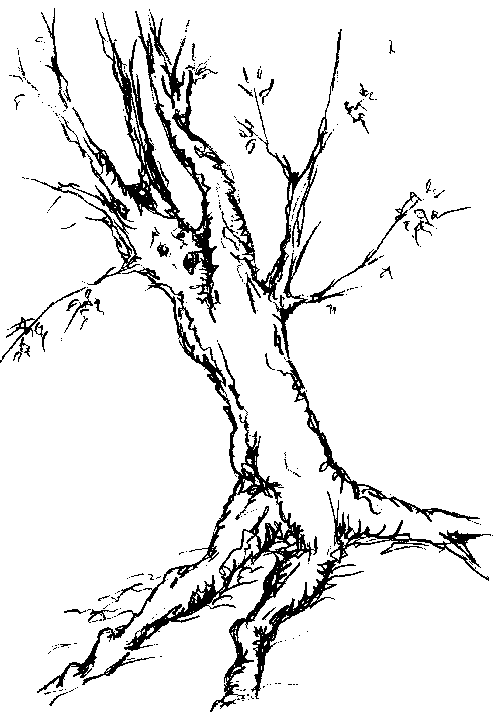
Ariel imprisoned in a tree by Sycorax
Credit: Burning Coal
While Akbar, Jahangir and then Shah Jahan were appreciative of Hindu culture, Shah Jahan’s son Aurangzeb enforced strict Islam. He destroyed many Hindu temples. As a courtier, I disagreed with his actions. My rebellion was not taken kindly and I was thrown in prison. I, who had seen centuries of history, possessed knowledge of several kingdoms, was left to rot in a tiny cell. I could not have freed myself: Once I choose a life form, I have to live until the mortal shell dies. Aurangzeb died in 1707 but my imprisonment continued.

A parallel development was happening during my imprisonment which was to be of great significance to Indian history. In 1702, the East India Company was revamped and the United East India Company was formed. In 1757, the Battle of Plassey brought new rulers to this country. I served in a rudimentary capacity to the British rulers until I could master their language. This happened because of one Lord Macaulay, who said in his address to the British Parliament on 2nd February, 1835:
The dialects commonly spoken amongst the natives of this part of India contain neither literary or scientific information, and are, moreover so poor and rude .... means of pursuing higher studies can at present be effected only by means of some language not vernacular amongst them ... who could deny that a single shelf of a good European library was worth the whole native literature of India and Arabia” (Source: Scribd.com)

Alas, this was not enrichment of culture. This was destruction of the kind Aurangzeb wrecked. It was like building a new church with the stones of the fallen temple. But let us leave this tale for another day. I will tell you how I managed under the British rule in my next post. 

Enhanced by Zemanta

Thursday, July 26, 2012

Meri Kahaani 1.0 : Ariel's Story

The next three posts on this blog are going to be like a serial novel. It is a fictional, historical re-imagining of The Tempest by William Shakespeare, mapping it onto Indian history from 1526 AD to 2007 AD. The piece contains two posts from the August 2007 archive of Ariel’s blog, Meri Kahaani, which chronicles his life experiences. His blog posts are autobiographical but are considered fictional by the modern scientific world.
Credit: Chest of Books
Ariel is a spirit in The Tempest who does the bidding of a European wizard, Prospero, the displaced Duke of Milan. Prospero comes to live in an island after a coup of his dukedom. Ariel is a native inhabitant of that island. The other Tempest characters which appear here are Sycorax and Caliban. In the play, Caliban is the son of Sycorax, a witch from Algeria who was exiled on the island. Caliban believes that the island rightfully belongs to him and has been stolen by Prospero. He attempts to overthrow Prospero by conspiring with two stranded servants from a ship after the tempest. In the island life, Caliban is forced to serve as a servant to Prospero and his daughter, a position he hates. Ariel also serves Prospero using his own magical powers and longs for his liberty. Unlike Caliban, Prospero has promised Ariel his freedom at some time. 

If you want a summary of the play, you can find it here on Sparknotes. For the text of the entire play, you can check out No Fear Shakespeare. No Fear Shakespeare puts Shakespeare's language side-by-side with a facing-page translation into modern English—the kind of English people actually speak today.

In the re-imagination, Ariel is an immortal spirit who has lived in India forever. His outer form is that of a human who is intelligent and accomplished and, is destined to serve the ruler of the land. He changes forms with each ruler, thus nobody realises he has lived forever. For the purpose of this piece, India in any time period refers to the mainland of Indian subcontinent, even though it was not consolidated until the Mughal Empire

Credit: InglesBlog
The superimposition of the play and history was motivated by the question of Ariel’s language. His verses to Ferdinand, the prince of Naples, show that Ariel has a good command over Prospero’s language unlike Caliban who possesses only rudimentary vocabulary. Ariel is a spirit and it can be assumed that the island is his natural habitat. So he is, in effect, a native dweller of the island much before Sycorax arrives there. At the end of The Tempest, while Caliban’s freedom comes with a sense of loneliness, Ariel’s freedom is more joyful as he is free to enjoy the island as he pleases along with his kind, namely the gods – Ceres, Juno etc.

The next post will be up tomorrow. The first blog post written by Ariel.

Enhanced by Zemanta

Tuesday, July 24, 2012

India Dimming

In the fourth quarter of financial year 2011-12, India’s growth rate dipped to 5.3%, the lowest rate since 2003. On June 22, 2012, rupee depreciated to a record low of INR 57.15 against US dollar. In the same month, food inflation was at 10.81 percent. A country that was termed as the next global super-power suddenly seems to be in a mess. Was India’s success story just a flash in the pan?