Showing posts with label Poetry. Show all posts

Sunday, November 4, 2012

Chandni Chowk : A Heritage Walk

The alarm rings at 8, I want to sleep a little more on this hazy Sunday morning. But, I get up because the glimmer of Chandni Chowk beckons. A heritage walk to Jama Masjid nestled withing the old, walled city of Shahjahanabad is an exercise in seeing fleeting glimpses of the 17th and 19th century. The walk director conjures up images of a proud Shah Jahan sauntering into his beautiful city in 1648 and Mirza Ghalib lamenting its demise after the freedom struggle of 1857.

Isfahan during 17th century. Credit: Isfahan Municipality Portal
Shah Jahan's new capital was built to outshine the city of Isfahan in Persia, and it did so. Shahjahanabad was a gorgeous walled city with 14 gates and a webbed layout. Delhi as a city has been constantly recreated and this counts as the 6th among the 7 Delhis. 4 of Shahjahanabad's gates exist as structures today: Kashmiri gate, Ajmeri gate, Turkman gate and Delhi gate. We saw Kashimiri gate during the heritage walk on the 1857 mutiny.

Credit: www.traveladventures.org
This walk began at Chawri Bazaar metro station and ended at Chandni Chowk metro station. But, this little space houses sprawling dimensions of heritage.

Saturday, July 28, 2012

Meri Kahaani 1.2 : Transient yet Eternal 2.0

My cellphone’s shrieking alarm woke me up some time ago. Here I sit, fingers poised above the keyboard, wondering how best to capture the cacophonous, jarring period of Indian history that was the British rule.

Indo-European language family tree
I had to master English in order to function effectively under the British officials. Here again, the script was completely new to me. I had become accustomed to writing from right to left, now reverse gears were required again. The locals treated the English as “pardesi hamlaavar” or foreign invaders. But in my study of languages, I discovered that Hindi and English belong to different branches of the same Indo-European language family. Despite the metamorphosis that happened in both languages, there are some cognates i.e. words with same roots: naam-name, janam-generate, mata-mother, patthar-Peter etc. The study of English opened up a whole new world of literature to me as most of European literature was available in English. I could have read about new scientific inventions too. But this knowledge was inaccessible for me. I was supposed to memorise the name of every king and queen who sat on the British throne but my knowledge of science remained confined to the basics.

Deliberate suppression can make even a rusted spring exert its strength. So it was with me. I thought of what the British gave me but it was not sufficient to quench my soul. When they chanted that their religion and culture was supreme, my ancient pride rose up. While I was studying, I was appalled to hear of the cruel treatment meted out to those who dared to rebel. The heavy handedness kindled contempt within my breast but I did not dare to speak out for fear of retribution. My English mind then created these lines:

Blown from cannon, hung and shot,
Torn in pieces, India to rot,
Bayonets sprouting blood and gore,
Stop the carnage, Please no more.

The sepoy mutiny of 1857 was a violent bloodbath. The Indian National Congress had been set up in 1885 but it only discussed the issues of English-educated Indians. I was heartened by the first flicker of sovereignty when Annie Besant founded the Home Rule League with Lokmanya Tilak in 1916. I had supported Britain in the First World War. After the war was over, Swaraj beckoned. But, it was not granted. I served the British again in World War II. By that time, I was fully supporting the Indian freedom movement led by Mahatma Gandhi. I participated in the demand for freedom, although being a civil servant made that a low-key request. There were some who disagreed with this style of freedom movement. They were dubbed radicals and ultimately they turned to violent revolution in order to overthrow the British Rule. One such individual was Subhash Chandra Bose. He sought help first from Adolf Hitler in Germany and later from Japan to overthrow the British rule. The attempts did not succeed. Also, Subhash Chandra Bose realised that Germany and Japan both were becoming the masters in this alliance. He left Germany for this reason. Even though his Indian National Army took control over the Andaman and Nicobar Islands, their administration remained in the hands of Japanese navy. An iconic figure, Bose has been lost in the wild after his alleged death in 1945.

Two years after World War II ended, India got independence in 1947. The farewell given to Lord Mountbatten was India’s last offering to the British rule. After Independence, India has seen its ups and downs while fighting the legacy of its colonial past and rediscovering its ancient heritage. English, given as a tool by the British, became India’s strength in a globalised world. Today, an average Indian whose mother tongue is supposedly Hindi, speaks in a mixture of Hindi, Urdu and English. School textbooks often emphasise the slogan ‘unity in diversity’ for Indian population. But I would say this is not merely unity: It is creation of a new identity where being Indian transcends any single linguistic identity. Children here are born polygots. Today, I can be perfectly understood in India when I write like this:

Viraasat ki neemat lekar, present time ki lagaam pakado
Vartamaan ki seedhi chaddhkar, future ko bright banao
Meaning:
Taking the blessing of your inheritance, catch the reins of your present
Climbing on the stairs of your present, make your future bright


The first part of this story is in the post Meri Kahaani 1.1. If you are wondering what got me started on this track, read Meri Kahaani 1.0

Enhanced by Zemanta

Friday, July 27, 2012

Meri Kahaani 1.1 : Transient yet Eternal 1.0

The context for this story is in yesterday's post Meri Kahaani 1.0
It was a quiet day at the office today. But too much silence perturbs me. Is this the portent of tempestuous times ahead? I looked at the calendar and realised that today is Bhadrapada Shukla Navmi. Many centuries have gone by, but I can never forget that on this day I became a part of the Mughal Emperor Akbar’s court. As a Central Government bureaucrat, I know the approved markings of India’s border. But I also remember the India that was unified for the first time by Akbar. If I tell tales of those times, will anybody believe me?

The Mughal rule began in India when Babur defeated Sultan Ibrahim Lodi of the Delhi Sultanate in the Battle of Panipat in 1526. I was serving Krishnadevaraya at that time. Kannada was the language used most in his court. From there I went to Raja Bharmal’s in Amber. When he married his daughter to Akbar in 1562, I moved again and became a part of Akbar’s court. I had learnt Hindi in Amber and had hoped to use it in Akbar’s court too. However, despite Akbar’s support for Hindu culture and Hindi; being his courtier, I was forced to learn Persian. This was completely different from any language I had learnt before. My knowledge of Sanskrit had always helped me pick up the language of any court in India. Whenever I struggled, I used to remember this shloka:

Abu'l-Fazl ibn Mubarak
presenting
 Akbarnama to Akbar
(Credit: 
Wikipedia)
उद्यमेन हि सिध्यन्ति कार्याणि न मनेारथै ।।
न हि सुप्तस्य सिंहस्य प्रविशन्ति मुखे मृग: ।।
Udyamen hi sidhyanti, karyaani na manorathayee,
Na hi suptasya sinhasya, pravishanti mukhe mrigah

This means work gets done only by action, not by thoughts alone. Just like a sleeping lion’s mouth does not get a deer by simply dreaming of it. I used to think of it over and over again, and plough on. But Persian! Even the script of that language is in reverse, from right to left. I really had to put myself to the task to become proficient in it. Just as I had mastered the language, I heard whisperings of a new language in the country. It was called Urdu and was born when Persian and Hindi combined. Another mixing was happening in this melting pot of a nation. However, the courtiers refused to use it. They called it a ‘base’ language, only to be used by the crude and the uneducated.  The Rajputs were proud of their Hindi and the Mughal courtiers wouldn’t dream of diluting their Persian. But languages have a way of sneaking in and Urdu thrived. I changed with the winds and had long lost the concept of cultural purity. At that time I said:

कुछ नई है परिंदों की चहक, कुछ नई है फ़िज़ाओं में महक
है दुनिया की फ़ितरत बदलना, वक्त का तकाज़ा हमेशा चलना
Kuchh nayi hai parindon ki chahak, kuchh nayi hai fizaon mein mahak,
Hai duniya ki fitrat badalnaa, waqt ka takazaa hameshaa chalnaa
Meaning,
There is something new in the chirping of birds, 
there is something new in the smell of the air,
It is the world’s nature to change; 
it is the time’s demand to always move.

I remember a noble ruler who would not dream of giving up his sovereignty to Akbar. Indians revere him to this day for his heroic nature - Maharana Pratap. He was proud of his native Rajput identity and treated the Mughals as invaders and intruders in India. Even after losing the battle of Haldi Ghati, Maharana Pratap kept engaging in guerrilla warfare. So many lives were lost in those battles! Wouldn’t it have been better for him to accept the Mughal rule? He and his population could have lived in peace and comfort while still maintaining their Hindu identity.

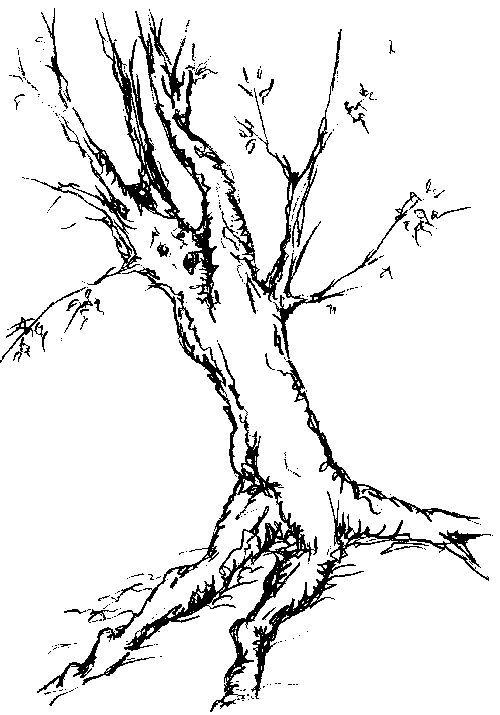
Ariel imprisoned in a tree by Sycorax
Credit: Burning Coal
While Akbar, Jahangir and then Shah Jahan were appreciative of Hindu culture, Shah Jahan’s son Aurangzeb enforced strict Islam. He destroyed many Hindu temples. As a courtier, I disagreed with his actions. My rebellion was not taken kindly and I was thrown in prison. I, who had seen centuries of history, possessed knowledge of several kingdoms, was left to rot in a tiny cell. I could not have freed myself: Once I choose a life form, I have to live until the mortal shell dies. Aurangzeb died in 1707 but my imprisonment continued.

A parallel development was happening during my imprisonment which was to be of great significance to Indian history. In 1702, the East India Company was revamped and the United East India Company was formed. In 1757, the Battle of Plassey brought new rulers to this country. I served in a rudimentary capacity to the British rulers until I could master their language. This happened because of one Lord Macaulay, who said in his address to the British Parliament on 2nd February, 1835:
“The dialects commonly spoken amongst the natives of this part of India contain neither literary or scientific information, and are, moreover so poor and rude .... means of pursuing higher studies can at present be effected only by means of some language not vernacular amongst them ... who could deny that a single shelf of a good European library was worth the whole native literature of India and Arabia” (Source: Scribd.com)

Alas, this was not enrichment of culture. This was destruction of the kind Aurangzeb wrecked. It was like building a new church with the stones of the fallen temple. But let us leave this tale for another day. I will tell you how I managed under the British rule in my next post. 

Enhanced by Zemanta

Friday, April 6, 2012

Christmas Poem for Joshua

There’s a wreath of holly on my door
A big bright star and balloons galore;
There’s tinsel and glow-balls all around,
Streamers & flickering lights abound.

A decorated fir tree in the hall
Surrounded by gifts for one and all;
A crib on the teapoy tells the story
Of shepherds and wise-men meeting Joseph & Mary.

There’s a happy feeling in the air
And I smile as I close my eyes in prayer
I join my friends and family as they sing,
‘Happy Birthday dear Jesus, our Saviour, our King’.

Written by Saby John

Tuesday, November 15, 2011

Reviewing Conversations

Conversations are a part of our daily grind - the memorable moments and also the ones we'd rather forget. Some are stimulating, some are mundane. They capture thoughts of the speakers and the silence around them captures the unspoken expressions. One kind word can warm three winter months says a Japanese proverb. At the same time, the wounds by words are deeper than those by swords. It is this magic of words and situations that Rajeev Nanda has beautifully captured in his first fiction book "Conversations". 

The book is a collection of short stories. The setting is always urban and contemporary. The stories span from dreams to truths. It is a book that has benefited from crispy editing. While the first story ‘Splinters’ talks about dreams and how the protagonist has lost track of his own. The next one is still surreal with its conversations with God. There is a struggle with idealism in ‘Soldier’.  ‘The Taxi Ride’ is fiction within fiction while stories thereon have taken a touch of reality. The graduation from lofty heights to earthy depths is brilliantly assembled. Short pieces of poetry strewn amongst the stories add value to the book. At the same time, lines from these poems can be quoted by themselves:
E.g. from ‘I Have’
“I have a lifetime full of joy,
     But, all I need is a moment of ecstasy”.

The poet has penned universal experiences in ‘Darkness’:
“This one idea that was aborted,
Sits in my heart like a lump,
Like a still child in a womb.”

In the last poem, the ‘Misfit’ says:
“I kept quiet to contemplate,
Mirror and the reflection expectantly wait
I turned and walked away;
The mirror and reflection shattered lay.”

Coversations is a book that makes you think what would you have done in the protagonist’s place. It teaches without preaching. It is not a mystery thriller that binds yet it allures the reader with reality, which is a staggering feat to accomplish. The enigma in some of Rajeev Nanda’s stories reminds me of Anton Chekhov’s works - The questions hanging in the air after a story has ended. 

While the setting is urban, it is also very contemporary. Some of the stories are also based in the U.S. Rajeev has shown struggles within families when issues like adultery and extra-marital affairs arise. While the issues are not new, he has changed the angles. Whether his characters are fence sitters or on either sides of the line – there remains an element of unease and introspection. Incidentally, there is a poem called ‘Introspection’ :
“If I never talk to myself,
      Whom can I expect to speak to me?
If I fail to own myself,
      Whom can I expect to take charge of me?” 
                                                                                                           

In his stories, there is death but not grief. There is depression but not sorrow. There is envy but not jealousy. To experience these, read the book.
About the book:
Publisher: Leadstart Publishing Pvt Ltd
Price: India: ₹195              Elsewhere: US $14
ISBN: 978-93-81115-12-1
About the author:
Rajeev Nanda completed his graduation (B.Sc) in general sciences from D.A.V College in Jallandhar, Punjab (India) in 1984. He did post-graduate diploma in Computer Science and other professional certification courses in software & technology from various institutes in New Delhi while working for a startup.
After spending more than 10+ years in the US, he relocated to Bangalore to help Intel setup their IT group in India. His professional expertise lies in strategy, technology and management leadership.  More on his professional experience can be found on:  http://www.linkedin.com/in/rajeevnanda
He started writing at the age of 10. In his college years, he picked up controversial subjects, like atheism, to write for the college magazine. He published his first book (e-verything.com: How to map out a viable e-strategy) in 2001. His fiction writing was a private affair until 2005 when he uploaded sample stories on American Book Publishers’ (ABP) web-site. The editorial board of ABP extended the contract in Sep 2005 which resulted in the book ‘Conversations’ in 2009.

This review is a part of the Book Reviews Program at BlogAdda. Participate now to get free books!

Enhanced by Zemanta

Friday, August 19, 2011

Review of "Musings of a Wanderer"

Author: Shreya Chatterjee        ISBN:9381205006

"Musings of a Wanderer" is Shreya's first published work. This collection of poetry by Power Publishers is a slim volume at 96 pages and very conveniently priced at ₹100. She has written since her school days and her poetry has been published in magazines and blogs. Like most Indians, she is bilingual and writes both in her native tongue Bengali and English. Without further ado, lets talk about her book.

Shreya has captured everyday emotions with a simplicity and depth that is both touching and surprising. Touching because you would have experienced the same feelings some time or the other and her words hold the potential to evoke buried memories. Surprising, because at times, what she writes is so straightforward, one wonders why didn’t no one think of putting it this way before. E.g. while writing about her mother’s abandoned slippers,
“Perhaps they even
Had a rest outside the temple steps,
But who knows for how long.”
from ‘Her Foot Friend Played Hide and Seek’. Here, she beautifully crafts an ordinary image that conveys the tirelessness of a busy homemaker. Similarly in ‘A Quiet Stroll’,
“A stroll
By the quiet river,
Nibbling at
Grass strands.”

Many of her poems are based on the onset of monsoon. And almost every one of these is heartwarming as, though she chooses simple words and writes a short verse, she manages to draw a vivid image for her reader. E.g.
“My window weaving a new tale….
When a gush of wind drenched me wet…” from ‘A Shower at Night’ and
“A laughing face,
I rush outside,
To welcome
My first shower
In love with
Those once a year,
Raindrops.” from ‘In Love with Raindrops’

Though the above lines express the joy of the poet at the first rain of the season, melancholy is more pervasive a theme in this collection. I wonder why this would be so in such a young poetess. Although, I must confess that this surprise comes forth from an optimist and joyous soul who rarely pays homage to pain. Based on this collection, it is of course beyond my judgement to know whether sorrow is a dominant theme in all her work or it catches the fancy of the poetess’ pen alone. Shreya underlines this distinction in her work on the back cover of the book when she defines herself as a “writer by profession, poet by will”.  Her poems have not been grouped according to themes or tones. So the interplay of joy and sorrow can be a refreshing read or a bumpy ride depending on the readers’ mood.
“Even they speak
A volume of words
With their downcast eyes.” from ‘Downcast Eyes’ and
“Your silence
Softens
The sore toes
The aching heels.” from ‘Curiously Silent’

As you can make out from the above lines, the diversity in themes truly makes them expressions of a meandering traveller on the journey of life. In the anthology, there are love tales in ‘Two Cups of Coffee’, ‘Behind the Blinds’ and ‘Breaking’. There are tales of warriors and cries of the natives in ‘Warrior’ and ‘Voice’. There are also some poems that encompass social issues, these are the ones which captured my interest first out of the lot. The plight of child labourers is captured in ‘Child Labors…’
“I cry out at her glittering face
‘Books would FEED me
-But NEVER within hours’. ”. Indeed how true that is.
A dutiful women caged in her home in ‘Queen of Our Land’
“Given to the whims of an insolent husband
She wore a painful smile-
Scrubbed and polished,
-Kept things spick and span.”
Or “I am light that stays invisible” in ‘To Be a Woman’.

On the whole, the book is an interesting and different read. For all lovers of poetry, Shreya is one to watch out for. May her poems never get shackled by eight-letter words and nor the emotions so abstract as to be beyond the understanding of anyone but the poet.

This review is a part of the Book Reviews Program at BlogAdda. Participate now to get free books!


Enhanced by Zemanta