Showing posts with label Hindi. Show all posts

Monday, November 26, 2012

विचारों की यात्रा

डॉ पुरुषोत्तम अग्रवाल
क्रेडिट: बुक लवर 

आज बहुत दिनों बाद हिंदी साहित्य से रूबरू होने का मौका मिला| अवसर था डॉ. पुरुषोत्तम अग्रवाल की पुस्तक के विमोचन का| किताब का नाम है “हिंदी सराय : अस्त्राखान वाया येरेवान”| विमोचन डॉ. कर्ण सिंह द्वारा किया गया जो कश्मीर के महाराजा हरी सिंह के पुत्र हैं और राज्य सभा सांसद भी हैं| अस्त्राखान रूस में है और येरेवान अर्मेनिया की राजधानी है| यह किताब वैसे तो अग्रवालजी की येरेवान और अस्त्राखान यात्रा का विवरण है, पर साथ ही साथ उन्होंने १७वीं सदी में अस्त्राखान में जाकर बसे भारतीयों के बारे में भी बात की है| जिस तरह से उन्होंने इतिहास, संस्कृति और विचारधाराओं को अपनी किताब में कुशलता से बुना है, उसके लिए कई वक्ताओं ने उनकी पुस्तक को मात्र पाँवों की यात्रा का विवरण की जगह “विचारों की यात्रा” का वर्णन कहा|

पहली वक्ता थीं सुश्री मन्नू मित्तल जो जवाहरलाल विश्वविद्यालय में इतिहास ही प्राध्यापिका हैं| उन्होनें एक बड़ी रोचक बात बताई – हम जो कपड़ों में “अस्तर” लगाते हैं, वो शब्द अस्त्राखान से आया है| हुआ यों की अस्त्राखान में कपड़ों का, खासकर फ़र का व्यापार होता था| और पहले कपड़ों में फ़र लगाया जाता था इसलिए वो अस्तर हो गया| संस्कृति के आदान-प्रदान के ऐसे कई सबूत मिलते हैं, जैसे कि कोणार्क के मंदिर में सूर्य देवता स्लाविक जूते पहने हुए हैं जबकि कोई भी हिन्दू देवी-देवता जूते पहने हुए नहीं दिखाए जाते|

Saturday, July 28, 2012

Meri Kahaani 1.2 : Transient yet Eternal 2.0

My cellphone’s shrieking alarm woke me up some time ago. Here I sit, fingers poised above the keyboard, wondering how best to capture the cacophonous, jarring period of Indian history that was the British rule.

Indo-European language family tree
I had to master English in order to function effectively under the British officials. Here again, the script was completely new to me. I had become accustomed to writing from right to left, now reverse gears were required again. The locals treated the English as “pardesi hamlaavar” or foreign invaders. But in my study of languages, I discovered that Hindi and English belong to different branches of the same Indo-European language family. Despite the metamorphosis that happened in both languages, there are some cognates i.e. words with same roots: naam-name, janam-generate, mata-mother, patthar-Peter etc. The study of English opened up a whole new world of literature to me as most of European literature was available in English. I could have read about new scientific inventions too. But this knowledge was inaccessible for me. I was supposed to memorise the name of every king and queen who sat on the British throne but my knowledge of science remained confined to the basics.

Deliberate suppression can make even a rusted spring exert its strength. So it was with me. I thought of what the British gave me but it was not sufficient to quench my soul. When they chanted that their religion and culture was supreme, my ancient pride rose up. While I was studying, I was appalled to hear of the cruel treatment meted out to those who dared to rebel. The heavy handedness kindled contempt within my breast but I did not dare to speak out for fear of retribution. My English mind then created these lines:

Blown from cannon, hung and shot,
Torn in pieces, India to rot,
Bayonets sprouting blood and gore,
Stop the carnage, Please no more.

The sepoy mutiny of 1857 was a violent bloodbath. The Indian National Congress had been set up in 1885 but it only discussed the issues of English-educated Indians. I was heartened by the first flicker of sovereignty when Annie Besant founded the Home Rule League with Lokmanya Tilak in 1916. I had supported Britain in the First World War. After the war was over, Swaraj beckoned. But, it was not granted. I served the British again in World War II. By that time, I was fully supporting the Indian freedom movement led by Mahatma Gandhi. I participated in the demand for freedom, although being a civil servant made that a low-key request. There were some who disagreed with this style of freedom movement. They were dubbed radicals and ultimately they turned to violent revolution in order to overthrow the British Rule. One such individual was Subhash Chandra Bose. He sought help first from Adolf Hitler in Germany and later from Japan to overthrow the British rule. The attempts did not succeed. Also, Subhash Chandra Bose realised that Germany and Japan both were becoming the masters in this alliance. He left Germany for this reason. Even though his Indian National Army took control over the Andaman and Nicobar Islands, their administration remained in the hands of Japanese navy. An iconic figure, Bose has been lost in the wild after his alleged death in 1945.

Two years after World War II ended, India got independence in 1947. The farewell given to Lord Mountbatten was India’s last offering to the British rule. After Independence, India has seen its ups and downs while fighting the legacy of its colonial past and rediscovering its ancient heritage. English, given as a tool by the British, became India’s strength in a globalised world. Today, an average Indian whose mother tongue is supposedly Hindi, speaks in a mixture of Hindi, Urdu and English. School textbooks often emphasise the slogan ‘unity in diversity’ for Indian population. But I would say this is not merely unity: It is creation of a new identity where being Indian transcends any single linguistic identity. Children here are born polygots. Today, I can be perfectly understood in India when I write like this:

Viraasat ki neemat lekar, present time ki lagaam pakado
Vartamaan ki seedhi chaddhkar, future ko bright banao
Meaning:
Taking the blessing of your inheritance, catch the reins of your present
Climbing on the stairs of your present, make your future bright


The first part of this story is in the post Meri Kahaani 1.1. If you are wondering what got me started on this track, read Meri Kahaani 1.0

Enhanced by Zemanta

Friday, July 27, 2012

Meri Kahaani 1.1 : Transient yet Eternal 1.0

The context for this story is in yesterday's post Meri Kahaani 1.0
It was a quiet day at the office today. But too much silence perturbs me. Is this the portent of tempestuous times ahead? I looked at the calendar and realised that today is Bhadrapada Shukla Navmi. Many centuries have gone by, but I can never forget that on this day I became a part of the Mughal Emperor Akbar’s court. As a Central Government bureaucrat, I know the approved markings of India’s border. But I also remember the India that was unified for the first time by Akbar. If I tell tales of those times, will anybody believe me?

The Mughal rule began in India when Babur defeated Sultan Ibrahim Lodi of the Delhi Sultanate in the Battle of Panipat in 1526. I was serving Krishnadevaraya at that time. Kannada was the language used most in his court. From there I went to Raja Bharmal’s in Amber. When he married his daughter to Akbar in 1562, I moved again and became a part of Akbar’s court. I had learnt Hindi in Amber and had hoped to use it in Akbar’s court too. However, despite Akbar’s support for Hindu culture and Hindi; being his courtier, I was forced to learn Persian. This was completely different from any language I had learnt before. My knowledge of Sanskrit had always helped me pick up the language of any court in India. Whenever I struggled, I used to remember this shloka:

Abu'l-Fazl ibn Mubarak
presenting
 Akbarnama to Akbar
(Credit: 
Wikipedia)
उद्यमेन हि सिध्यन्ति कार्याणि मनेारथै ।।
हि सुप्तस्य सिंहस्य प्रविशन्ति मुखे मृग: ।।
Udyamen hi sidhyanti, karyaani na manorathayee,
Na hi suptasya sinhasya, pravishanti mukhe mrigah

This means work gets done only by action, not by thoughts alone. Just like a sleeping lion’s mouth does not get a deer by simply dreaming of it. I used to think of it over and over again, and plough on. But Persian! Even the script of that language is in reverse, from right to left. I really had to put myself to the task to become proficient in it. Just as I had mastered the language, I heard whisperings of a new language in the country. It was called Urdu and was born when Persian and Hindi combined. Another mixing was happening in this melting pot of a nation. However, the courtiers refused to use it. They called it a ‘base’ language, only to be used by the crude and the uneducated.  The Rajputs were proud of their Hindi and the Mughal courtiers wouldn’t dream of diluting their Persian. But languages have a way of sneaking in and Urdu thrived. I changed with the winds and had long lost the concept of cultural purity. At that time I said:

कुछ नई है परिंदों की चहक, कुछ नई है फ़िज़ाओं में महक
है दुनिया की फ़ितरत बदलना, वक्त का तकाज़ा हमेशा चलना
Kuchh nayi hai parindon ki chahak, kuchh nayi hai fizaon mein mahak,
Hai duniya ki fitrat badalnaa, waqt ka takazaa hameshaa chalnaa
Meaning,
There is something new in the chirping of birds, 
there is something new in the smell of the air,
It is the world’s nature to change; 
it is the time’s demand to always move.

I remember a noble ruler who would not dream of giving up his sovereignty to Akbar. Indians revere him to this day for his heroic nature - Maharana Pratap. He was proud of his native Rajput identity and treated the Mughals as invaders and intruders in India. Even after losing the battle of Haldi Ghati, Maharana Pratap kept engaging in guerrilla warfare. So many lives were lost in those battles! Wouldn’t it have been better for him to accept the Mughal rule? He and his population could have lived in peace and comfort while still maintaining their Hindu identity.

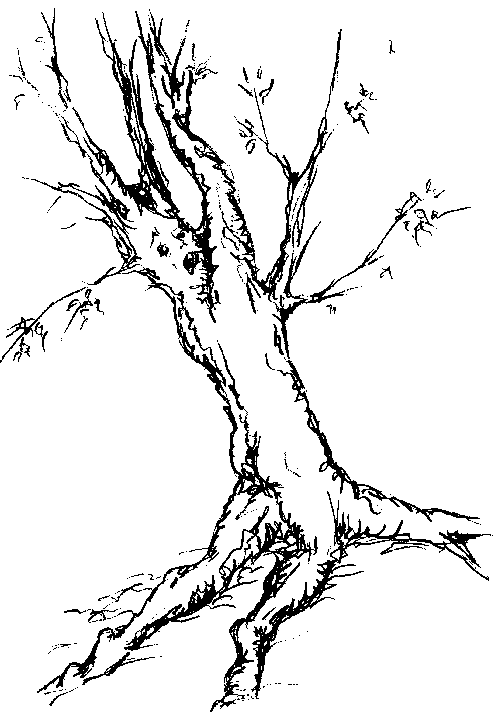
Ariel imprisoned in a tree by Sycorax
Credit: Burning Coal
While Akbar, Jahangir and then Shah Jahan were appreciative of Hindu culture, Shah Jahan’s son Aurangzeb enforced strict Islam. He destroyed many Hindu temples. As a courtier, I disagreed with his actions. My rebellion was not taken kindly and I was thrown in prison. I, who had seen centuries of history, possessed knowledge of several kingdoms, was left to rot in a tiny cell. I could not have freed myself: Once I choose a life form, I have to live until the mortal shell dies. Aurangzeb died in 1707 but my imprisonment continued.

A parallel development was happening during my imprisonment which was to be of great significance to Indian history. In 1702, the East India Company was revamped and the United East India Company was formed. In 1757, the Battle of Plassey brought new rulers to this country. I served in a rudimentary capacity to the British rulers until I could master their language. This happened because of one Lord Macaulay, who said in his address to the British Parliament on 2nd February, 1835:
The dialects commonly spoken amongst the natives of this part of India contain neither literary or scientific information, and are, moreover so poor and rude .... means of pursuing higher studies can at present be effected only by means of some language not vernacular amongst them ... who could deny that a single shelf of a good European library was worth the whole native literature of India and Arabia” (Source: Scribd.com)

Alas, this was not enrichment of culture. This was destruction of the kind Aurangzeb wrecked. It was like building a new church with the stones of the fallen temple. But let us leave this tale for another day. I will tell you how I managed under the British rule in my next post. 

Enhanced by Zemanta

Saturday, August 28, 2010

Get them on the shelf

Steacie Science and Engineering Library at Yor...Image via WikipediaDo you like reading or do you dislike it?
If you like reading, do you have a title in mind that isn't on the library shelf? Please tell me about it.
If you don't like reading, there must be one or two books that you have heard of. If you want to read them in near future, please let me know.

The books will be ordered for BITS library. Even if you are not a BITSian, you can suggest books that a college library should have.

Any genre which suits general reading will do. Novels, biographies, travelogues, anthologies....... Because as Sir Francis Bacon said "Some books are to be tasted, others to be swallowed and some few to be chewed and digested. "

For BITSians, please check in the catalogue that the book isn't already present. (They don't believe in two copies.)
Also, it'll be really nice of you if you could tell me the publisher and ISBN. You need to Google only one book, poor me will have to plough through the whole list.

The empty comment box is waiting for you....
Enhanced by Zemanta

Tuesday, August 24, 2010

यादें

कॉलेज का आखिरी साल, हर लम्हे को पूरी तरह जी लेने का जज़्बा लेकर आता है| हर कोई कहता है कि यह चार साल ज़िन्दगी के सबसे सुनहरे साल हैं, जितनी मस्ती कर सकते हो कर लो| पर यथार्थ में यही ज़िन्दगी की नींव के सबसे महत्त्वपूर्ण पत्थर भी होते हैं| चौथे साल तक भविष्य कि चिंता दस्तक देने लगती है, साथ ही दोस्तों की अहमियत महसूस होती है | इस उधेड़बुन के बीच मैं यह चिट्ठा लिख रही हूँ, कॉलेज के रंगीन दिनों पर | कुछ दोस्त विदाई ले चुके हैं, बाकीयों से बिछुड़ने का अहसास है |  पर होठों पर सदा मुस्कान लायेंगी कॉलेज कि ये यादें ........


PS: If you are a non-Hindi reader, don't worry, I won't be writing the memoir completely in Hindi :P